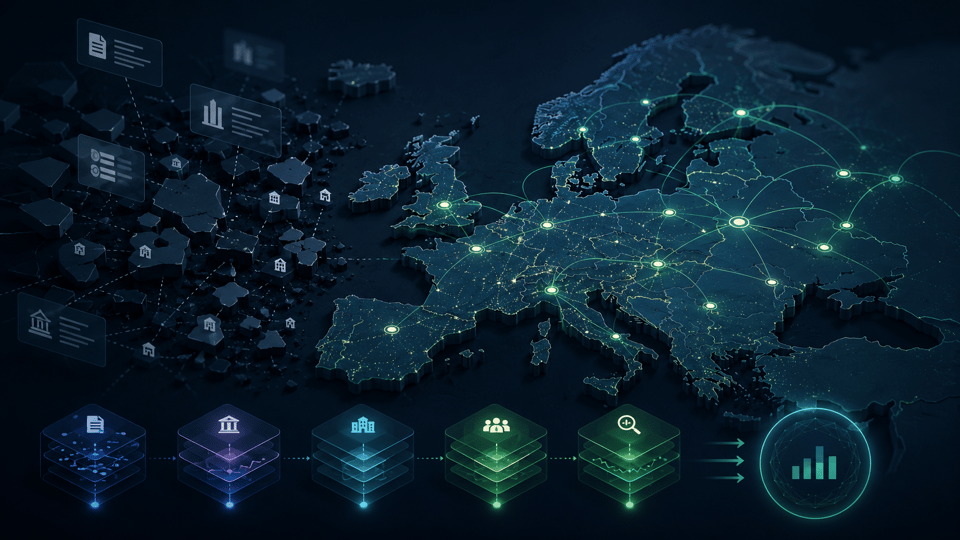

Many buyers evaluating private-market intelligence platforms now ask the same question:
“Why not just use ChatGPT?”
It is a reasonable question.
Large language models are extremely powerful. They can accelerate research, summarise information, structure analysis, support brainstorming, and improve workflow speed across a wide range of tasks. AI is clearly transforming how deal teams work.
But there is an important distinction between AI workflows and trusted intelligence infrastructure.
That distinction becomes especially important in private markets, where visibility is often fragmented and the cost of incomplete information can be high.
AI systems still depend on underlying intelligence
Large language models are reasoning systems and they do not inherently possess complete, verified private-market visibility. Their usefulness depends heavily on the quality of the underlying data, the structure of the information, the reliability of the sources, and the contextual depth available inside the workflow itself.
In private markets, much of the most valuable intelligence is fragmented, difficult to verify, partially hidden, regionally complex, and not fully available through public web data. That creates important limitations for generic AI workflows.
AI can synthesise information extremely well. But if the underlying intelligence is incomplete or disconnected, the output may still miss critical context. This becomes especially relevant in fragmented European markets where ownership structures, filings, and strategic relationships are often distributed across multiple jurisdictions and systems.
Why private markets require contextual intelligence
Deal teams increasingly require ownership visibility, harmonised company intelligence, transaction context, relationship mapping, verified datasets, and workflow-native analysis capable of connecting fragmented information into a usable strategic picture.
Without that contextual layer, AI-generated outputs can appear highly convincing while still missing important signals beneath the surface. That creates real economic risk across workflows such as M&A sourcing, buyer discovery, acquisition analysis, market mapping, and strategic screening.
The challenge is whether the intelligence layer beneath the AI is strong enough to support real strategic decisions.
AI is valuable but not sufficient by itself
The future is unlikely to be AI versus intelligence platforms. It is more likely AI operating on top of trusted intelligence systems. That is an important distinction.
AI can improve speed, synthesis, workflow efficiency, and discovery. But trusted intelligence improves visibility, verification, contextual understanding, and decision confidence.
The strongest workflows increasingly combine both.
As AI adoption accelerates, the strategic value of trusted datasets actually increases rather than decreases. The more workflows become AI-assisted, the more important it becomes to ensure the underlying intelligence is structured, contextual, and reliable.
Why verification matters even more in the AI era
As AI-generated outputs become more common, trust becomes more valuable.
Enterprise buyers increasingly care about reliability, verification, repeatability, workflow confidence, and contextual depth. And that is especially true in high-consequence environments where weak assumptions can create real downstream risk.
This is particularly true in fragmented European private markets where ownership structures are layered, local filings matter, harmonisation is difficult, and relationships often shape outcomes beneath the surface of visible market activity.
In these environments, trusted intelligence infrastructure becomes strategically important and the value is not simply faster answers. The value is higher-confidence decisions.
The real strategic question
The future question is probably not:
“Should deal teams use AI?” They already are.
The more important question is:
“What intelligence layer should power those workflows?”
AI workflows are becoming increasingly common. Trusted private-market intelligence remains difficult to build.
And in high-stakes dealmaking, the quality of the underlying intelligence layer often determines the quality of the decision itself.